
Search Results for: flexible commuter

RELEASE: Advocates Cheer DC Council’s Unanimous Vote For Flexible Commuter Benefits
For Immediate Release
April 7, 2020
Contact: Cheryl Cort, Coalition for Smarter Growth
T. 202-675-0016, www.smartergrowth.net/parkingcashout
Advocates Cheer DC Council’s Unanimous Vote for Flexible Commuter Benefits
Employees will be eligible for walk, bike, transit commute benefits equal to an offered parking benefit
The Coalition for Smarter Growth celebrated today the success of its three-year campaign for flexible commuter benefits. “We are thrilled that today the DC Council voted unanimously for the Transportation Benefits Equity Act (B23-148). This new law will allow an employee who is offered a parking benefit by their employer to use the equivalent value of the parking subsidy for a transit, walk, or bike commute,” said Cheryl Cort, Policy Director for the Coalition for Smarter Growth.
“This bill incentivizes more sustainable commuting as commuters return to work on the other side of the current crisis. The importance of bicycle transportation has emerged in the crisis as an alternative to other modes, and this new law will help boost this option,” said Cort. Once workers can return to their daily routine, the new law will give many employees the opportunity to exchange a parking space for a bike (or walk or transit) commute. This could push DC’s current 18% walk and bike to work rate even higher, helping to reduce traffic congestion, pollution, and crashes.
“We have worked on this issue for a number of years, with dozens of meetings, outreach to the community, and extensive negotiations. The final legislation involved many compromises. However, the core of the bill is intact, and will start making a difference with most employers who offer subsidized parking,” said Cort.
The Transportation Benefits Equity Act requires employers who provide free or subsidized parking to employees to offer those same employees alternatives that include:
- Employer-paid transit benefits;
- Taxable cash for employees who walk, bicycle, or ride in a carpool to work, or who take transit (where cash would make up any difference between the value of the parking and transit cost);
- Increased employer contribution to an employee’s healthcare benefit;
Employers also have the option to:
- Develop a Transportation Demand Management (TDM) plan to reduce vehicle commute trips toward the moveDC goal of 25% or less of employees’ commute trips made by car or taxi (assisted by and approved by DC Department of Transportation);
- Pay a sizable Clean Air Compliance fee to support TDM measures for each parking benefit offered;
- Cease subsidized parking.
The law includes the following exemptions:
- Employers that currently own the parking used for employees are exempt from this law.
- Existing leased parking: if an employer has an existing lease for parking provided to employees, the employer must comply with the new rules at the end of the current lease.
- Employers that do not provide subsidized parking are exempt.
- Employers with 20 or fewer employees are exempt.
One of the largest compromises given to employers was the full exclusion of currently owned parking. This means that essentially all major institutions, like universities, are likely to be exempt. While some of these institutions also lease parking, the bill exempts them if they are running shuttles to leased parking lots half a mile or more away, or if they have a Campus Plan with a Transportation Demand Management (TDM) Plan already approved by DC Department of Transportation.
“The bill will provide flexible commute benefits to many downtown workers, likely reducing rush hour traffic. This can reduce congestion, speed up buses, cut pollution, and even reduce crashes,” said Cort. “It will keep DC in the forefront of cities implementing more sustainable transportation.”
###
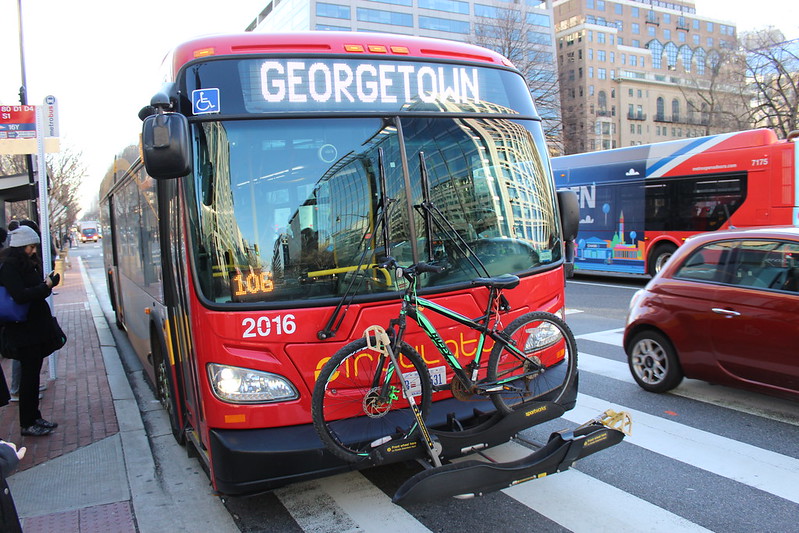
Photo credit: Elvert Barnes, Flickr
Flexible commuter benefits bill reintroduced in DC
On February 19, 2019, D.C. Councilmembers Charles Allen and Mary Cheh reintroduced the parking cash-out bill, B23-148. This bill will require employers that subsidize parking for an employee’s commute to offer a transit benefit of equal value, or provide cash. It doesnt impose a cost or a new benefit, it simply lets an employee choose to use an employer-provided commute benefit for something other than driving and parking.
What’s the next step?: voting it out of the Transportation & Environment committee and into the full Council. Councilmembers Todd (Ward 4), and McDuffie (Ward 5) have not yet said if they will support the bill. If you are a business owner or constituent, let your councilmember know you support this sensible bill to let an employee use an employer’s parking benefit for an alternative commute.
Here are the options an employer can provide as an alternative to employees for a parking-only subsidy:
- transit benefit of equal value to parking subsidy
- cash of equal value to parking subsidy
- increased health coverage benefit
- cease to offer parking subsidies
- Transportation Demand Management Plan that helps achieve the moveDC plan goal of under 25% commute trips by car or taxi
The bill has one major change: it exempts parking that is owned — rather than leased or paid for — by an employer. While we are disappointed in this exemption, we still believe the bill covering employers that lease or pay for employee commuter parking will have important benefits. These benefits include: reduced traffic congestion (especially in downtown); increased bus speeds; increased transit, walk, and bike commutes; reduced greenhouse gas and other pollutant emissions; and fewer traffic crashes. View the factsheet here, or learn more about the campaign here.

Flexible Commuter Benefits

On April 7, 2020, the DC Council voted unanimously to support flexible commuter benefits. This action addresses today’s commuter benefits which don’t match commuter preferences. Most DC residents don’t drive to work. Instead, they bike, walk, or take transit. In fact, 18% of DC residents walk or bicycle to work, 37% take transit, and only 34% drive alone.
When an employer offers a commuter subsidy benefit, it’s often for driving and parking. Even when a subsidy is available for transit or bicycling it is often for much less than the value of the parking benefit. On April 7, 2020, the DC Council voted to change that!
We are grateful to the DC Council and the Mayor Bowser Administration for supporting the bill that will grant more choice to commuters and incentivize greener and healthier commutes.
Resources
- The feature on NBC
- RELEASE: Advocates Cheer DC Council Unanimous Vote for Flexible Commuter Benefits
- View the amended bill, B23-148, passed unanimously on first vote (of two votes) on March 3, 2020, by the DC Council.
- For DC Residents: Flexible Commuter Benefits bill fact sheet
- For Employers: A better commuter benefit for your employees
Latest Happenings
A bit of good news for future sustainable commutes

RELEASE: Advocates Cheer DC Council’s Unanimous Vote For Flexible Commuter Benefits

ACTION: Tell the DC Council to support flexible commuter benefits
Examples of employers implementing parking cashout

ACTION: Tell the DC Council to support flexible commuter benefits
Photo: Kevin Kovaleski/Flickr
Tell Councilmember Todd you support flexible commute options!
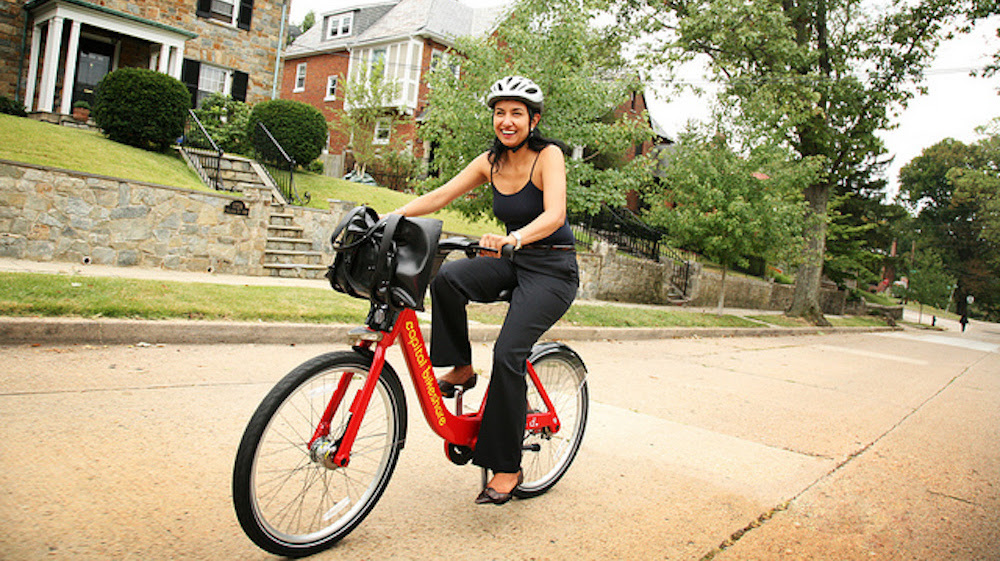
For several years, we’ve been working on a bill at the D.C. Council for flexible commuter benefits. The bill would let anyone who gets a parking benefit from their employer to put the equivalent value towards their biking, bus, Metro, or walking commute. It’s a change that would give D.C. workers more flexibility and take cars off the road – at no additional cost to employers.
We are now at a political crossroads. To advance the bill out of the Council committee, we need one more vote – either Councilmember McDuffie or Todd (we’ve already got Councilmembers Cheh and Allen). Please help us encourage these Councilmembers to support the bill. Show your Councilmember that his constituents are paying attention and want flexible commuter benefits!
Click here to let Councilmember Todd know that you support this important bill.
What’s in the bill?
The Transportation Benefits Equity Amendment Act 2019 Bill 23-148 builds on the existing pre-tax transit benefit employers offer to employees at no cost. This bill requires that if an employee turns down a parking space offered by their employer, they would be provided the equivalent value for an alternative commute benefit – like riding transit, walking or bicycling.
B23-148 is largely the same as last year’s bill, applying to employers with 20 or more employees that choose to subsidize employee car parking. One change in the reintroduced bill exempts employers that own their parking spaces. While the Coalition for Smarter Growth is disappointed in this provision, overall, B23-148 is an important bill to reduce traffic and pollution, encourage more sustainable commuting, and give employees better transportation choices.
Email your councilmember today.
To win this groundbreaking commuter benefits bill, we need you! As a constituent of Ward 4 Councilmember Todd, let him know that you to support this bill.
Want to do more? Call Councilmember Todd‘s office 202-724-8052 and politely tell their staff (or leave a voicemail) that you support the commuter benefits bill (Bill 23-148).
Have questions on the policy, the details, or what else we have to say on flexible commuter benefits? Check out our factsheet here, and our issue page here, or reply to this email with your question!
Photo/credit Womanonbike_

RELEASE: Groups laud flexible commute benefits bill to give employees more sustainable commute options
FOR IMMEDIATE RELEASE
March 8, 2017
CONTACT
Cheryl Cort, Coalition for Smarter Growth
202-251-7516
cheryl@smartergrowth.net
Groups laud flexible commute benefits bill to give employees more sustainable commute options
Washington, DC – Today, DC Councilmembers Mary Cheh and Charles Allen introduced a bill to allow residents to opt for cash or transit benefits in lieu of an employer-provided parking space. DC environmental, transportation, and smart growth groups applauded the legislation.
“Enabling workers to choose a more sustainable commute is a winner for everyone. Instead of the current practice, which provides more incentive to drive, this bill allows for equal benefits to be offered to those who choose other commute modes. This bill lets workers convert an employer-paid parking space into cash and choose to walk, take transit, or bicycle rather than drive. It reduces traffic and pollution, incentivizes a healthier commute, gives workers flexibility in their commutes, and is paid for with a parking space that’s not needed,” said Cheryl Cort, the Policy Director at the Coalition for Smarter Growth.
More than 18 percent of DC residents walk or bike to work, but the only commute benefit offered by many employers is a parking space. This bill introduced today, named the Transportation Benefits Equity Act of 2017 [PDF of bill text], requires that if an employer provides a parking benefit to an employee, the worker can opt to take the equivalent value of the parking space, and instead walk, bike, or ride transit to work.
“Rather than a parking-only commute benefit, this gives people flexibility to choose to bicycle to work if they prefer. Why shouldn’t people who walk or bike to work be offered the same commute benefit as someone who prefers to drive?” asked Greg Billing, the Executive Director of the Washington Area Bicyclist Association.
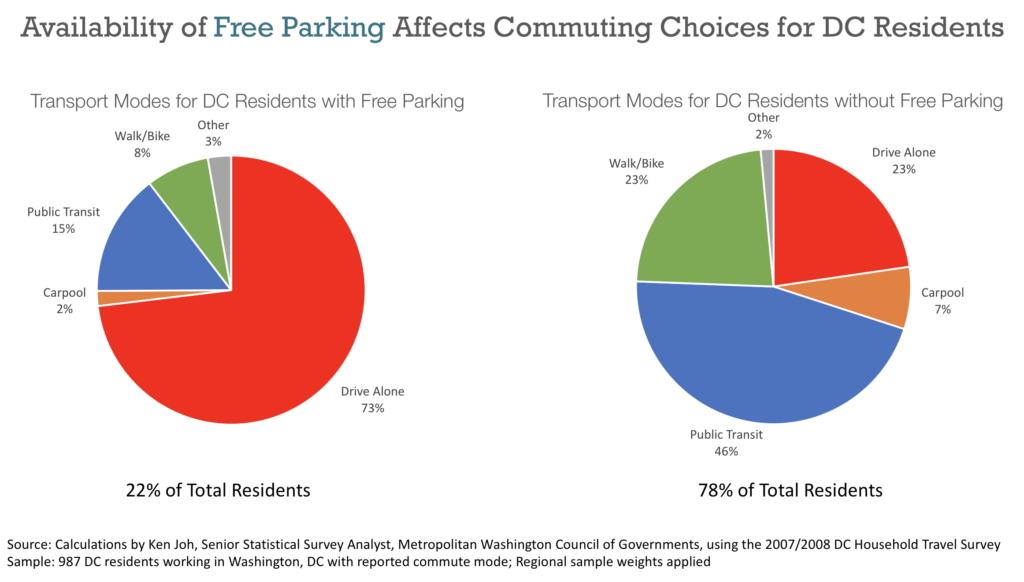
Workers who are offered a subsidized parking space at work are far more likely to drive than if they do not receive a commute subsidy. While half of commuters to DC jobs drive when they do not receive any kind of commute benefit, the number jumps to 85% driving and parking when given free or subsidized parking.
“This is a painless way to cut traffic congestion and pollution, while making DC’s workplaces more competitive, and rewarding workers for making healthier choices. This bill would cement DC’s status as a transportation innovator and as the number one big city in America for people who walk and bike to work,” said Payton Chung of the Sierra Club DC Chapter.
“DC is tied for the highest walk and bike to work rate in the country. With this bill, even more residents will be attracted to walking and bicycling to work, rather than driving, incentivizing the most sustainable and healthiest kind of commuting there is. We see great value to employers in improved employee health and productivity and lower health insurance costs,” said Moira McCauley of All Walks DC, a pedestrian advocacy group.
The bill builds on DC’s Commuter Benefit law, which requires all employers with 20 or more employees to provide workers with the option to use their own pre-tax money to commute by transit. The small modifications employers were required to make to their payroll systems to administer pre-tax benefits also make for very easy administration of a flexible parking benefit that employees, can choose to swap for a tax-free transit benefit, taxable cash, or a combination of the two.
The bill would require an employer who provides a parking benefit to allow workers to opt for spending the equivalent value of that benefit on transit, and/or combine with taxable cash and walk or bicycle to work.
Employers would continue to offer whatever commuter benefits they choose, including parking benefits, but would also be required to flex a parking benefit to transit or taxable cash if the eligible employee requests it.
“Many workers are attracted to DC because it’s so walkable and bikable,“ said Cort. “More than one third of households don’t own a car. With this landmark flexible commuter benefits law, DC would top the list of cities offering the most sustainable commutes for their workforce. This is good for business, good for commuters, and good for the city.”
For more information, see our fact sheet: https://www.smartergrowth.net/wp-content/uploads/2017/03/bill-residents-parking-cashout-fact-sheet_CJ.pdf
About the Coalition for Smarter Growth
The Coalition for Smarter Growth is the leading organization in the Washington DC region dedicated to making the case for smart growth. Its mission is to promote walkable, inclusive, and transit-oriented communities, and the land use and transportation policies and investments needed to make those communities flourish. Learn more at smartergrowth.net.
###